Freitag, 28. Januar 2011

Art + Argument at K3, Zürich


SAVE THE DATE!

Without a market, no-one would make art

17h, 20 February 2011

K3 Project Space

Maag Areal

Hardstrasse 219

CH 8005 Zürich

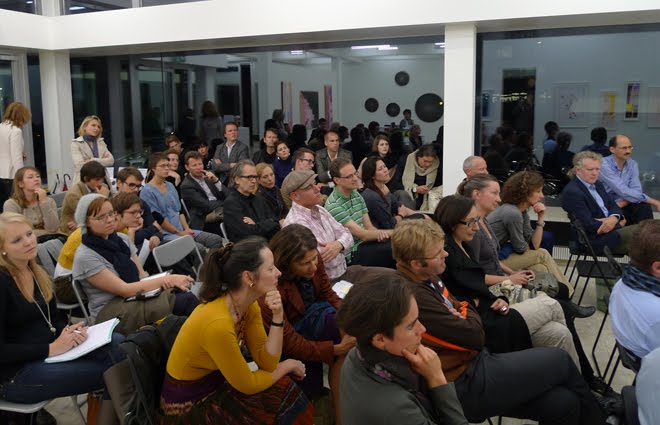
Four cultural experts in two opposing teams debate artists’ motivation and what the market means. Teams must oppose or defend the motion, and each team member has five minutes to argue their case uninterrupted. After that speakers challenge each other and the audience may in turn question the speakers. The event will end with a vote for the more persuasive team. 


This is a forum for discussing culture where the unspeakable may be said. Each speaker must play his or her assigned role, regardless of whether they agree or not. Speakers benefit from temporary immunity: what they say during the debate is not necessarily their opinion and they cannot be held to their word afterwards.

Art + Argument is an itinerant event bringing together exciting minds from the Swiss art scene and beyond. To know more, write to aoiferosenmeyer(at)gmail.com or visit

Four cultural experts in two opposing teams debate artists’ motivation and what the market means. Teams must oppose or defend the motion, and each team member has five minutes to argue their case uninterrupted. After that speakers challenge each other and the audience may in turn question the speakers. The event will end with a vote for the more persuasive team. 


This is a forum for discussing culture where the unspeakable may be said. Each speaker must play his or her assigned role, regardless of whether they agree or not. Speakers benefit from temporary immunity: what they say during the debate is not necessarily their opinion and they cannot be held to their word afterwards.

Art + Argument is an itinerant event bringing together exciting minds from the Swiss art scene and beyond. To know more, write to aoiferosenmeyer(at)gmail.com or visit www.k3zh.ch

Donnerstag, 23. Dezember 2010

Art + Argument on World Radio Switzerland

On the 15th December 2010, Art + Argument at Claudia Groeflin Gallery was featured on Jennifer Davies’ Swiss By Design programme on World Radio Switzerland. You can listen to the programme online here:

http://worldradio.ch/wrs/programmes/culture/swiss-by-design-art-and-argument-karl-moser-and-bi.shtml?22255

Thank you Jennifer!

Donnerstag, 16. Dezember 2010

Art + Argument at Claudia Groeflin Galerie

On December 9th 2010, Morgan Falconer and Dimitrina Sevova mounted a spirited defence of the motion: (When it comes to art) we are still painting on the walls of caves. Giovanni Carmine and Fabian Chiquet were to contest their position and speak for change in art.

Please bear in mind the premise of Art + Argument! What was said during the event should not be understood to represent the opinion of the speakers.

Morgan opened, admitting that the complexity of the works by significant artists such as Andy Warhol or Marcel Duchamp would suggest that a comparison between their work and that of cave painters is ridiculous. But is that merely arrogance? Given the ability of man to create failure, a clear example being recent economic crisis, “art has spent enough time trying to convince us that we are more sophisticated than we really are”. In fact, cave painting and recent art can be seen to share the same representational basis: I draw the world and therefore understand it better. But ultimately, the need to make art can be seen as an urge, one shared by modern and prehistoric man. ”The urge to art” said Morgan “is an urge not necessarily to represent and to know, but also perhaps an urge to play, to transgress and perhaps destroy. As many failed artists will tell you, art is something you keep doing because you just can’t stop doing it.”

Fabian was first to counter the proposition. Art found in caves, he stated, arrested the moment; it documented and preserved. Today, art is much more than that, (and other people are much better than artists at documentary). Art is part of a broader entertainment industry, an industry intimately connected to technical progress; without engaging with technological advances, art would lose its audiences. Longevity no longer matters to art: “it’s about being part of something, making something happen”. Despite the paintings on the walls around him, Fabian was willing to state that “we’re not painting any more; we’re doing things that are much more interesting”.

Dimitrina had brought a trophy to prove her points, a poster for the 1950 film Prehistoric Women. We are living in a speculative world, she said, and the meaning or purpose of disciplines such as science, philosophy or literature is ever less clearly defined. So what can we say about art? Beuys said art is not here to explain anything; Socrates said we are blind, and have not seen the world, just the so-called material world. And what do we know about cave painting? Not much! We cannot interpret cave paintings because we know nothing of the social context in which they were made, though we can research the methods and techniques used to make them. These people had the same DNA as ours, and looked like us. Prehistoric people did not live in caves, but rather were nomads. And yet something drove them to enter deep into dangerous caves and paint on inaccessible walls. Cave painting was based not only on a well-organized visual language, but also on a well-developed studio work process in which the entire community supported the master painter. There are countless overlapping myths and allegories about what cave painting may have meant for its practitioners. The Platonic myth of the cave is very powerful on a cultural level, and we cannot separate our encounter with cave paintings from our cultural, philosophical and ethical interpretations of the gaze, of the viewer and of relations between light and shadows. Dimitrina also quoted Susan Sontag, who wrote that we are no longer painting the cave, as the cave is everywhere and we are the cave. It is great that we are living amid these speculations, Dimitrina summed up, which are kinds of storytelling, and reiterating Morgan’s statements, she said: “we need walls and we need holes in these walls, we need blank sheets of paper, canvases, screens. It’s part of our drives as human beings.”


Giovanni Carmine began his rejection of the motion by questioning whether cave painting really was the beginning of what we know as art today. “We look at it as if it were art – but I think it was an attempt [by the painters] to go over traumatic experiences they were having with bison and dinosaurs.” (He continued, rather contrarily for his line of argument, that artists today continue to work through traumas, making the curator feel like a psychiatrist or psychologist.) The Chilean miners who recently were trapped for weeks underground could be seen as a parallel – they did not have to paint on the walls of their mines, as they were being supplied with psychiatric medication. So while art survives, the need to paint one’s issues diminishes. Giovanni stated in closing: “art is not about representation!”


The ensuing debate ranged over recent and pre-historic history. Our ancestors’ complexity was understood and contested, recognised and rejected. The threat posed by Mickey Mouse was compared with that of raging bison, and the effort required to make paintings in the dark with the technical feats of art the contemporary world. The art canon was help up for examination, and recent history that tried to change the nature of art ridiculed. When it came to a final vote, Dimitrina and Morgan, proposing the motion, were judged by the majority to be the more convincing, though many in the audience abstained, and instead put some further ideas to the test after votes were cast.

Many thanks to all the participants, to the audience and to Claudia Groeflin for the invitation to debate in her gallery.

For more information on Art + Argument please contact aoiferosenmeyer (at) gmail.com

Donnerstag, 18. November 2010

Art + Argument at Claudia Groeflin Galerie


SAVE THE DATE!


(When it comes to art,)

we are still painting on the walls of caves


9th December 2010, 19h30

Claudia Groeflin Galerie

Dienerstrasse 12

8004 Zurich


Four cultural experts in two opposing teams debate art and painting today. Teams must oppose or defend the motion, and each team member has five minutes to argue their case uninterrupted. After the speakers challenge each other, the audience may in turn question the speakers. The event ends with a vote for the more persuasive team.

This is a forum for discussing culture where the unspeakable may be said. Each speaker must play his or her assigned role, regardless of whether they agree or not. Speakers benefit from temporary immunity: what they say during the debate is not necessarily their opinion and they cannot be held to their word afterwards.

Art + Argument is an itinerant event bringing together exciting minds from the Swiss art scene and beyond. To know more, write to aoiferosenmeyer(at)gmail.com.

Montag, 11. Oktober 2010

Art + Argument at Anne Mosseri-Marlio Galerie


Please note, the opinions quoted in this blog are not necessarily those of the speakers!

On 5th November a keen crowd was present for Art + Argument at Anne Mosseri-Marlio Galerie. Kathleen Bühler opened the defense of the motion ‘This house believes art is dangerous’ by citing two works by the performance artist Marina Abramovic. In Art Must Be Beautiful, Artist Must Be Beautiful, 1975, Abramovic brushes her hair ever more violently while saying the title of the work repeatedly. The work points to two aspects of beauty – the social and the aesthetic tradition; in a “delicious contradiction” the artist is attacking the tool she is using. 35 years later, Abramovic stages the work The Artist Is Present, 2010, in MoMA New York, in which she looks directly into the eyes of members of the audience sitting opposite her. In the intervening period, however, she has enhanced her appearance, appearing almost as youthful as in 1975. She is within her rights to do so of course, but as an artist who uses her body as her medium, it cannot go unnoticed, nor that she collaborates with fashion house Givenchy. “Beauty, noted Bühler, “is dangerous because its lure is so strong that even critical thinkers such as Abramovic forget their initial resistance.”

Samuel Leuenberger started the opposition on a pragmatic note, citing the mechanisms of the art world. Museums, collectors, galleries and the public operate within an economy that understands beauty as that which people agree is such. Thus beauty is defined in retrospect “by a set of people rather than by the item itself – if the right curator, the right critic, right collector, right artist come together and decide that something is good, it becomes good and potentially beautiful”. (Leuenberger would later cite Richard Prince as an artist whose work was thus recognised.) This consensus makes for a solidity of collections and a stable market – but not dangerous beauty.

Barnaby Drabble spoke of being made a pariah when, as a student at Goldsmiths, he dared to call a work beautiful. In an attempt to find out why it proved so outré, Drabble sought a definition for beauty, looking to two sources outside of art writing, firstly the 3rd Earl of Shaftesbury. In the Swiss Alps he encountered 'beauty inconsistent with reason … beauty mingled with horror, fear and despair'. This beauty hinted at the inadequacy of reason, while the beauty Henry David Thoreau observed in Walden was borne of observing nature, re-connecting with it and re-experiencing time. Beauty, as Jeremy Gilbert-Rolfe has noted, is intransitive and beyond discourse, and, Drabble noted, “proposes the inadequacy of a modernist idea of progress“. “Clearly in its countering of reason, of history and of progress it [beauty] is subversive, or at least has subversive potential.”

Adam Szymczyk began his opposition in an unexpected fashion. He too looked outside aesthetics, choosing three poet’s quotations. First Arthur Rimbaud’s rejection of beauty in the preface to A Season in Hell: ‘One evening, I sat beauty on my knees. And I found her bitter. And I reviled her.’ Isidore Lucien Ducasse, writing as the Comte de Lautréamont described beauty found ‘in the chance meeting on a dissecting-table of a sewing-machine and an umbrella’. These sources manifest the transformation from an idealistic notion of beauty to beauty as contemporary sublime. In the early 20th century it was defined in relation to the horrors of World War I, as Rainer Maria Rilke’s elegy prophesied: For beauty is nothing, but the beginning of terror, which we still are just able to endure, and we are so awed because it serenely disdains to annihilate us.’ Szymczyk reasoned, that as “three great writers of modernity involve the element of terror and despair in beauty – that would be to say that beauty is dangerous – so I cannot strictly keep to my argument, but the way I would like to defend the argument I was given, is that I completely disagree with the line of argument proposed by my predecessors”.

From this point both teams were swift to counter their opponents’ statements, and Szymczyk proved that any initial sense of security on the part of Bühler and Drabble would be proved false. In fact, he said, “I would totally leave [beauty] out from discussion and preserve it as something strictly private; it is not something that can be subject to a discussion that can be verified. Historically you can follow this discussion, but it still doesn’t teach us anything about the nature of the notion that seems to be completely overblown, so it blocks the possibility of discussing other categories and leads to simple laziness. But still I don’t think that this is dangerous, this is just slightly useless. I don’t feel threatened.”

The ensuing discussion circled around arbiters of quality, the use of beauty, its definitions and the danger of danger. Members of the audience probed the panel on beauty defined by capital rather than the social, the subjectivity of art and on the supplanting of the aesthetic with the critical, and how the aesthetic can ultimately re-absorb this supposedly critical.

In the close closing vote the proposition (Bühler and Drabble) won by 16 votes to 13, (with several abstentions) though Drabble and Bühler both admitted they agreed with their opponents’ arguments!

Many thanks to all the participants, to the audience and to Anne Mosseri-Marlio for the generous invitation to host the event in her gallery.

For more information on Art + Argument please contact aoiferosenmeyer (at) gmail.com

Montag, 27. September 2010

Participants confirmed for Art + Argument, 5 October 2010


Kathleen Bühler, Barnaby Drabble, Samuel Leuenberger and Adam Szymczyk debate risk and aesthetics

October 5, 2010

7:00 PM

Anne Mosseri-Marlio Galerie

Bleicherweg 33

CH-8002 Zurich

Mittwoch, 8. September 2010

Art + Argument at Anne Mosseri-Marlio Galerie


SAVE THE DATE!

This house believes beauty is dangerous

October 5, 2010

7:00 PM

Anne Mosseri-Marlio Galerie

Bleicherweg 33

CH-8002 Zurich

Four cultural experts in two opposing teams debate beauty and art. Teams must oppose or defend the motion, and each team member has five minutes to argue their case uninterrupted. After the speakers challenge each other, the audience may in turn question the speakers. The event ends with a vote for the more persuasive team. 


This is a forum for discussing culture where the unspeakable may be said. Each speaker must play his or her assigned role, regardless of whether they agree or not. Speakers benefit from temporary immunity: what they say during the debate is not necessarily their opinion and they cannot be held to their word afterwards. 


Art + Argument is an itinerant event bringing together exciting minds from the Swiss art scene and beyond. To know more, write to aoiferosenmeyer(at)gmail.com